

We know how important research is to all the families we support and on this page we aim to bring you interesting and relevant information related to JIA, uveitis and paediatric rheumatology research.
Scroll down to find information on:
- Current research studies needing participants
- Current research surveys needing your input
- Reports, Findings & Publications
Are you a researcher and would like to involve CCAA or the families we support in your work?
Please get in touch with us by completing the Research Request Form using the link below.
Getting involved in research can be a positive and rewarding experience!
It is quite likely that you and your family may be asked to take part in research at some point. Thanks to families who have participated in research in the past, new treatments and better ways of supporting children and families with JIA continue to be developed.
Many families appreciate that siblings can often be included too. Taking part in research can help families feel they are doing something positive following their child’s diagnosis, while also helping other families in the future. It can also be a good opportunity to meet other families in similar situations.
Research consent forms can sometimes appear long or complicated but please do not let this put you off. If there is anything you do not understand, you can always ask the researcher to explain it. No question is ever too small or unimportant.
Hospital visits can already feel busy and stressful, especially if you have young children with you. If a researcher approaches you but the timing does not suit you, it is absolutely fine to ask for their contact details so that you can speak with them at a better time for you. Researchers understand this and will usually do everything they can to make sure you feel supported and have the information you need.
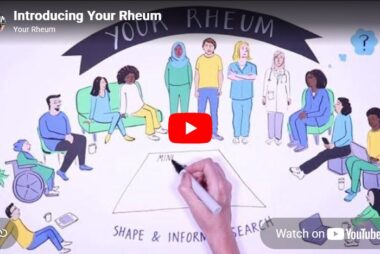
‘Your Rheum’ An ongoing research group for young people
If you are a young person aged between 11-24 and you are interested in research, then you might like to join Your Rheum. There is a short video on YouTube explaining a bit about what happens at Your Rheum. Being involved is a great way to meet others in the same position as you and to make a difference.
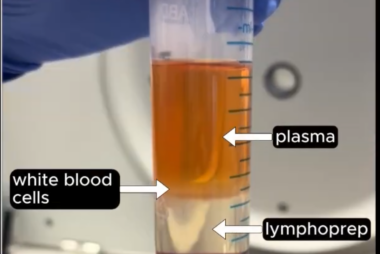
A day in the life of your blood sample
Ever wondered what happens to your blood when you give it for research? We are very excited to bring you this brand new ‘behind-the-scenes’ film on TikTok made in collaboration with a young person with JIA. Follow a research blood sample inside the lab alongside researcher Nia. NB: As with all our content, we recommend that parents of younger children watch this themselves first before sharing with their child.
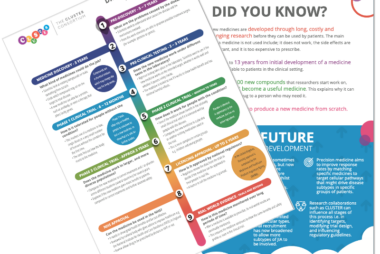
Ever wondered about how new medications are discovered and how long it takes?
The Cluster Champions, a group of patients and parents working alongside the Cluster Consortium, have collaborated with the Cluster Industry Committee and Cluster Researchers to develop an infographic that describes the journey of drug development.
Researchers need you!
Spotlight on…..
‘Managing Treatment eXperience’ (MTX) study
We are excited to collaborate with researcher Dr Daniela Ghio and Professor of Child Health Literacy, Lucy Bray, on this new project, which puts children and families at the heart of improving treatment experiences for young people living with rheumatic conditions
The study, funded by the National Institute for Health and Care Research (NIHR), will co-create engaging, child-friendly resources to help children better understand and manage methotrexate. Children, parents, and healthcare professionals have all highlighted the urgent need for better information about methotrexate—designed with children, for children.
“Children have told us that taking methotrexate is one of the hardest parts of their condition,” says Daniela. “This project is about listening to their voices and co-creating tools that make a real difference in their treatment journey.”
Over the next 18 months, the research team will:
- Speak with 40 children aged 6–16 to understand their experiences with methotrexate
- Run creative workshops with children and parents to co-design resources like animations, activity books, and prompt cards
- Test and refine these tools to make sure they’re useful, accessible, and empowering
All details about this project can be found at www.mtxstudy.co.uk
IMPACT Study for Families
This is a current study aiming to produce a chatbot support tool for parents who have a child diagnosed with a paediatric rheumatological condition.
IMPACT are often looking for young people, siblings and parents to help them with this important work.
For more info you can see their video here: https://www.theimpactstudy.co.uk/

The Childhood Uveitis Research PrioritieS Survey (CHURP)
Dr Lola Solebo is leading this important work around uveitis research.
Initial findings from a survey of families affected by uveitis have just been shared with us.
This survey allowed families themselves to prioritise the questions that they would like researchers to address – click here to read more.
More detailed reports from the survey are still being prepared and we will share them here as soon as they are available.
Meanwhile, Dr Solebo and her team have a new survey out now around AI and screening tools. If you would like to have your say click here:
Thanks to Dr Solebo and her team!
Other Research
Current research studies needing participants
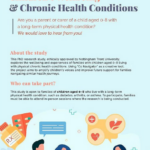
We are delighted to be able to share this in person opportunity for families living near Nottingham Trent University. The study is being conducted by Beccie Davis-Yates, Senior Lecturer & Associate Course Lead for Psychology. It has been designed to be a really fun activity session for children using ‘CoNavigator’ – a tool using colourful pegs, tiles and cubes to create a 3D map of everyone’s input!
What’s involved?
Participants will take part in 2 separate, in-person sessions designed to be both interactive and insightful. For children, this involves a 1 hour interactive session tailored to their age and needs, while parents or carers will participate in a separate 1 hour interactive session. These are held independently to ensure that both the children’s voices and the parents’ unique perspectives are fully captured and supported.
Why take part?
By participating in this study, you play a vital role in improving the collective understanding of children’s wellbeing and ensuring that their unique voices are heard. Your shared experiences provide the essential insights needed to develop better support systems for other families in the future. It is an opportunity to contribute to meaningful research that advocates for more compassionate and effective care for children living with chronic health conditions.
For more info and for any questions, please do get in touch with Beccie directly: beccie.davis-yates@ntu.ac.uk
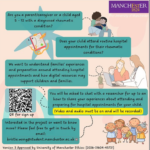
Have some good ideas about what could help families prepare for hospital appointments?
If so, Dr Dani Ghio and MSc Student Kristie Wong at the University of Manchester are working on this as a project and would love to hear from you!
For more information and to share your expertise, please email Kristie.wong@student.manchester.ac.uk
Design Research Fellow and Product Designer working with Sheffield University, Ursula Ankeny, is interested in figuring out what products might help children and young people living with JIA. She recognises the unmet need for products especially designed for this age group. She aims to work with children and their families to design, trial and disseminate some products! There are online or in person opportunities available so it does not matter where you are based.
If you think your child may enjoy getting involved in this, for more information or for any questions, please contact Ursula directly via email at u.ankeny@shu.ac.uk
This is run by researchers at the University of Manchester. It includes two studies called Biologics for Children with Rheumatic Diseases (BRCD) and British Society for Paediatric and Adolescent Rheumatology Etanercept Study (BSPAR ETN). These studies aim to look at the safety and effectiveness of biologic and bio similar treatment for Juvenile Idiopathic Arthritis (JIA).
You can read more about information for study participants: https://sites.manchester.ac.uk/bcrdbspar/for-participants/
Current research surveys needing your input
Dr Lola Solebo and Dr Sonali Dave are looking into screening tools for uveitis and how local services and AI might be helpful to make things more convenient for families.
They would love to hear your thoughts about how uveitis screening is done for children and young people.
At the moment, these checks usually happen in hospital, every two to four months, where doctors look into children’s eyes. A newer type of imaging, called AS-OCT, is being explored and has been shown to be accurate and objective. It could mean that screening happens closer to home, reducing the need for regular hospital visits. The images can also be reviewed using artificial intelligence.
If you’re happy to share your views, please click the link below to take part in a short survey. It usually takes 5-10 minutes, but can take up to 20 minutes for those who have more they want to tell us:
https://redcap.idhs.ucl.ac.uk/surveys/?s=MFKTRHH4FAAWCL8H
If you have any questions, feel free to get in touch with the research team:
Dr Sonali Dave
Email: sonali.dave@ucl.ac.uk
Tel: +44 20 3987 2189
Many of our followers based up North will know Dr Flora McErlane, Consultant Paediatric Rheumatologist based in Newcastle. Dr McErlane has asked us to share this survey with you.
The survey has been put together to find out more about patient experiences and preferences around treatment of non-systemic JIA. Your answers will help them identify what works well, what is difficult, and what matters most to patients and families. The findings will help feed into work that Dr McErlane and others are involved in to improve the treatment and care of people with JIA.
If you would like to contribute, you can find the survey here:
https://redcap.gaslini.org/redcap/surveys/?s=XW99YCJRAAAHACMJ
Reports, Findings and Publications
12 years ago, most rheumatology research focused only on adults or younger children. Adolescents often ‘missed out’ both in research and healthcare, leaving a big knowledge gap about this time of transition.
In 2012, the research teams at University College London (UCL) teamed up with rheumatology clinical teams at University College London Hospital (UCLH) and Great Ormond Street Hospital (GOSH). Together, they created the Centre for Adolescent Rheumatology, co-funded by Versus Arthritis and Great Ormond Street Hospital Charity, where doctors, nurses, researchers and patients work together on research projects that focus on adolescent health. This unique collaboration has led the way for a pioneering commitment to enhance and transform rheumatology care and research for young people.
You can read all about their work here:
Centre for Adolescent Rheumatology – Impact Report
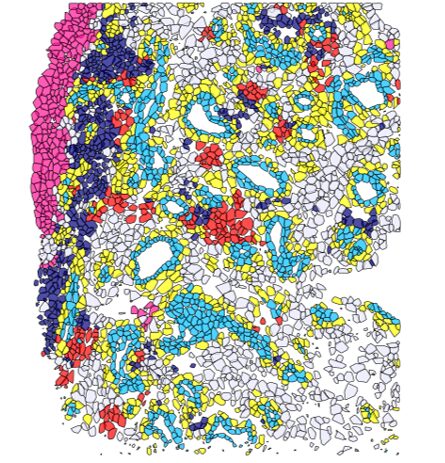
For the first time, researchers have been studying small samples of tissue from the inflamed joints of children and young people with JIA. This work and the new understanding it brings could pave the way for more personalised treatments, enabling the teams to select the most effective treatment for any individual.
Many of you may have seen the short news item about this on ITV but if you missed it, you can catch up here
We are sharing the lay summary, a short description of the study with analysis of this image and what the colours represent.
Our thanks go to the children, young people and their families involved for allowing researchers to use their joint tissue. And we would also like to thank the research teams involved from University of Birmingham, University College London, Birmingham Children’s Hospital, Great Ormond Street Hospital and University of Oxford.
We are pleased to announce that NCEPOD has released a new report – ‘Joint Care?’ – A review of the quality of care provided to children and young adults with juvenile idiopathic arthritis (JIA).
Click HERE to go to the study page where you can download the full report, summaries and additional QI resources. Please ask your healthcare team/GP if they have seen it.
Click here to watch the webinar recording marking the release of ‘Joint Care?’